Question: What if an LLM learned from easy to hard, the way humans do?
When pretraining a Korean language model from scratch, would presenting the same data from easy to difficult—the way humans learn—help the model learn faster than random shuffling? I designed and ran this personal experiment around that question. Because ordering can be changed without changing either the dataset or model size, it was worth isolating its effect. I trained a 110M-parameter model on a single pass over 2.5 billion tokens and compared a random baseline with three curriculum conditions.
The four orders were:
random: the baseline, with all data randomly shuffledlength: divide sentences into ten bands by length and train from shortest to longestdifficulty: train in ascending order of difficulty calculated from morphological statisticsmixed: mix 10–15% of the next difficulty band into the current band during training
random, length, and difficulty used the same corpus and changed only its order. mixed replaced the most
difficult 10% of tokens with easier data, so it includes a data-selection effect as well as an ordering effect. I
treated it as a separate condition from the outset to avoid interpreting that difference as a pure ordering
effect. All four conditions used exactly 2.5 billion training tokens.
Controlling everything except order
The model is a 110M-parameter decoder-only Transformer. It uses Llama-family RMSNorm, RoPE, and SwiGLU; I implemented both the model and training loop directly in PyTorch. The tokenizer is a 32k byte-level BPE trained with Hugging Face Tokenizers, and the input and output embeddings share weights.
| Data source | Measured share | License |
|---|---|---|
FineWeb2 kor_Hang (pinned revision) | 76.6% | ODC-By 1.0 |
| National Institute of Korean Language's Modu Corpus | 15.0% | Research use; redistribution prohibited |
| Korean Wikipedia 20231101 | 8.4% | CC BY-SA 4.0 |
I cleaned 4.55 million documents containing 6.8 billion characters to create a training pool of 2.94 billion tokens under the custom BPE. Processing included NFC normalization, Korean-character-ratio and length filters, and exact deduplication with BLAKE2 hashes. Content hashes determined the train/validation split, ensuring that a rerun assigns the same document to the same split. I used 8.32 million paragraph-preserving chunks of at most 512 tokens as the ordering units.
The shared corpus C for random, length, and difficulty contained 7.06 million chunks. For mixed, I removed
713,554 chunks from the highest-difficulty band (250 million tokens) and replaced them with 710,017 chunks from
the easiest 75% of the data, matching the total token count exactly.
I tested that runs with the same seed started from identical initial weights and generated each data order as a file before training so it remained fixed. Sentence-level shuffling could itself make the baseline a nonstandard training setup, so I chose chunks of at most 512 tokens as the unit of ordering.
Training ran in bf16 on a single RTX 4090 24GB instance in RunPod Secure Cloud. Throughput was approximately 90,000 tokens per second, each run took about 7.8 hours, and the full set of training and evaluation runs cost roughly USD 55–60. I initially planned three seed repetitions. After reviewing the first-seed results, however, I concluded that a potential confound between the learning-rate schedule and data order needed to be addressed first. I therefore prioritized four fixed-learning-rate runs with the same seed and corresponding data order over repeating seeds, comparing eight runs in total: four cosine-schedule runs and four fixed-rate runs.
Reproducible experiment design
I separated data collection, preprocessing, tokenizer training, tokenization, difficulty scoring, order
generation, training, and evaluation into the staged CLI
main.py prepare → tokenizer → score → orders → train → eval → plot. manifest.json records dataset revisions
and the exact data used, while orders/meta.json records the pregenerated order and hash for each condition. I
tested that comparison runs began from the same initial weights. For the fixed-LR reruns, I held the seed and
order constant and changed only lr = min_lr = 3e-4.
I also fixed checkpoint restoration to recover not only the data position but the CUDA RNG state, preventing loss
from changing across an interrupted-and-resumed run. In the process, I found that the checkpoint's
map_location moved even RNG-state tensors to the GPU and prevented their restoration. This code path was not
covered by CPU tests, so I changed the operating procedure to include a short interruption-and-resumption check
on the actual training device before a full run.
Hugging Face Datasets and Hub were used to retrieve corpora and benchmarks, while Tokenizers was used to train
the BPE. Transformers was used only in evaluation code that loaded external reference models; the experimental
model and its training loop were implemented directly in PyTorch. During KoGPT2 evaluation, I also found that
the Transformers GPT-2 wrapper split Korean tokenizer input at the byte level. I added a probe for Korean tokens
and loaded the raw tokenizers.Tokenizer instead. Producing a number and measuring the intended quantity are not
the same thing.
Results
| Condition | Final val loss | Tokens to target loss (3.645) | Final bits per character (BPC) |
|---|---|---|---|
| random | 3.505 | 1.38B tokens | 2.304 |
| mixed | 3.582 | 1.66B | 2.369 |
| difficulty | 3.632 | 1.81B | 2.470 |
| length | 3.645 | 1.99B | 2.414 |
The curriculum conditions required approximately 20–44% more tokens than random to reach the same loss. Their
rank order remained unchanged at every intermediate checkpoint, and the validation loss for length even rose
slightly from 3.643 to 3.645 near the end of training.
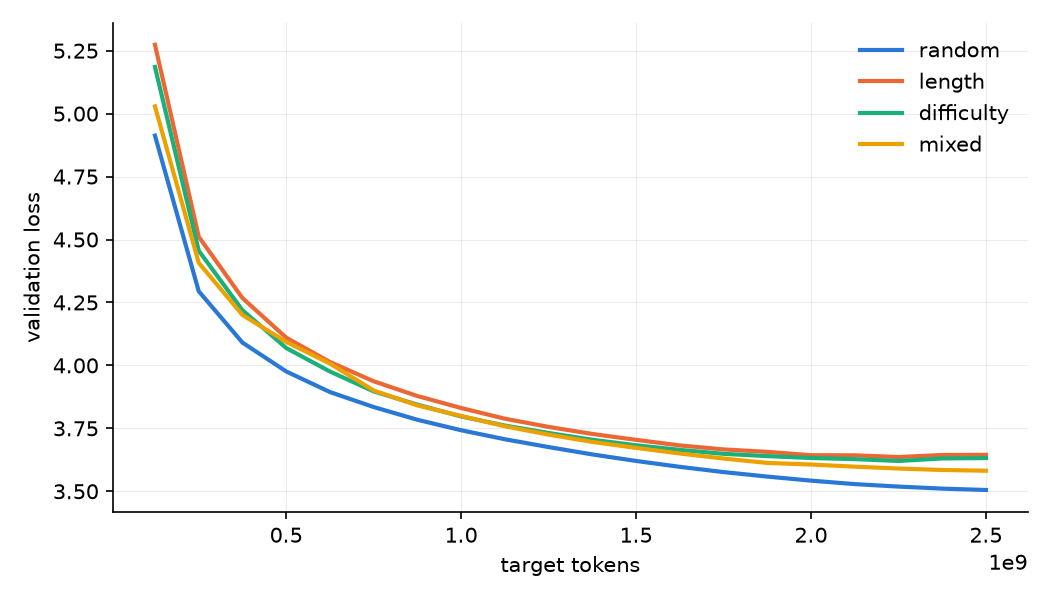
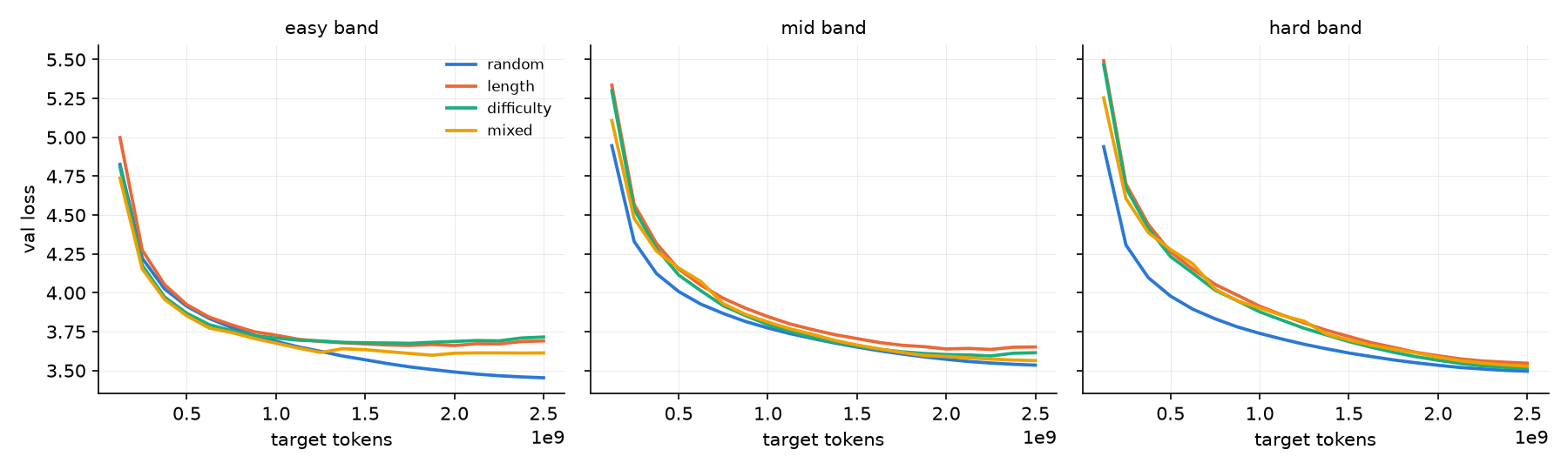
Aggregate loss alone could not explain the ranking, so I split validation results into difficulty bands. The
loss gaps between difficulty and random were +0.262 on easy data, +0.080 on medium data, and +0.017 on hard
data. The easy-band loss under curriculum training stopped improving after 1.2 billion tokens, consistent with
the explanation that performance deteriorated because the model never revisited the easy examples seen early in
training.
Fixed-learning-rate reruns
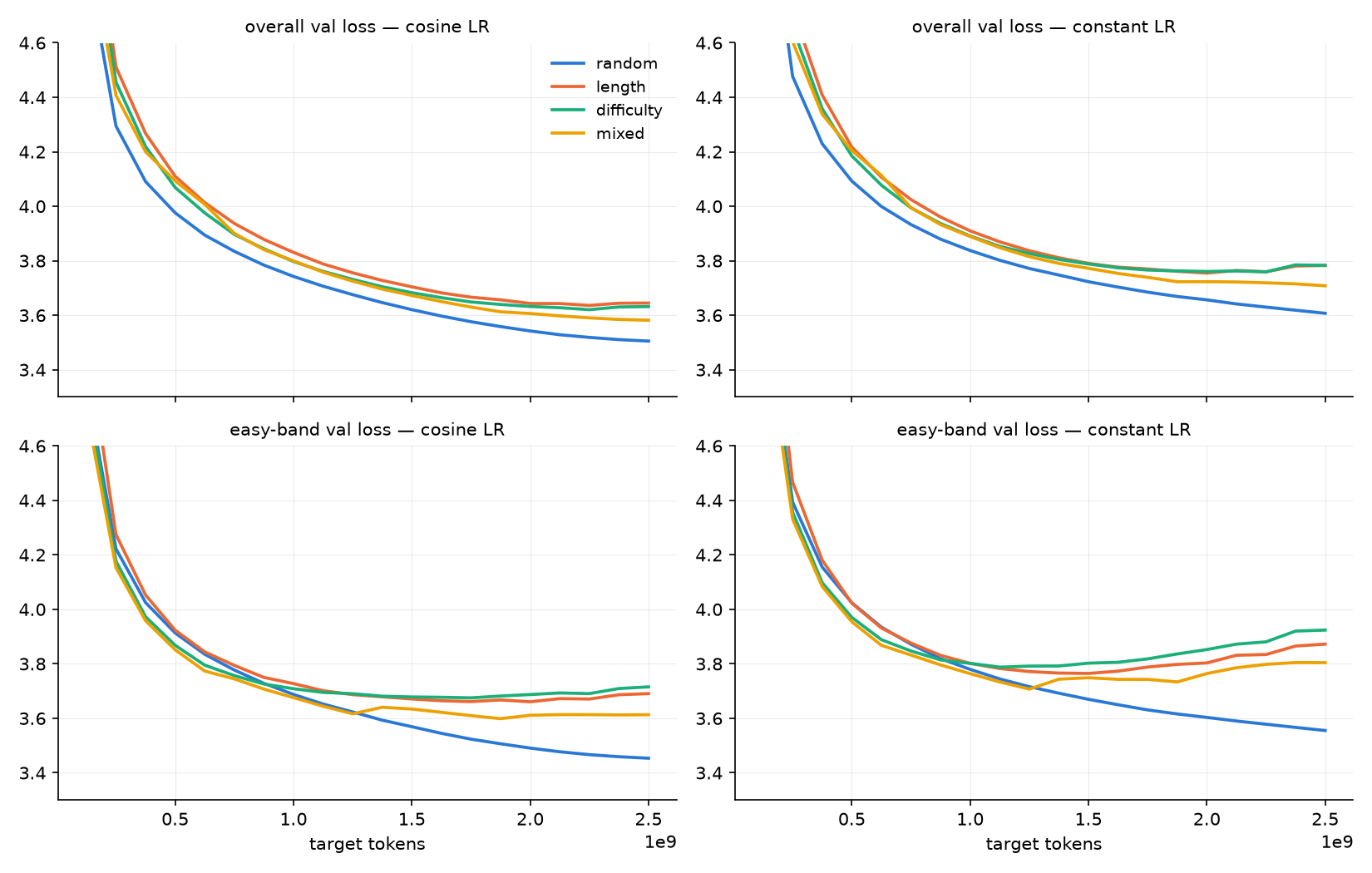
Under a cosine schedule, difficult data always appears in the low-learning-rate portion of training. Before calling the initial result an ordering effect, I needed to examine this confound. I therefore retrained all four conditions with the same seed and data order while holding the learning rate fixed at 3e-4.
With the fixed learning rate, difficulty's validation-loss gap relative to random increased from +0.127 to
+0.176, and the easy-band gap grew from +0.262 to +0.369. The condition ranking also remained unchanged. If
cosine decay had created the apparent effect, these gaps should have narrowed; instead, they widened. Cosine
decay alone therefore could not explain the difference, leaving the failure to revisit easy data as the leading
explanation.
Benchmarks
I shuffled outputs for 20 fixed prompts without revealing condition names and asked two LLM judges to compare
them. Among cases where both judges chose the same winner, random beat difficulty 12–2; a two-sided binomial
test yielded p ≈ 0.013. random also led length 10–5 and mixed 9–6, but neither comparison was statistically
significant.
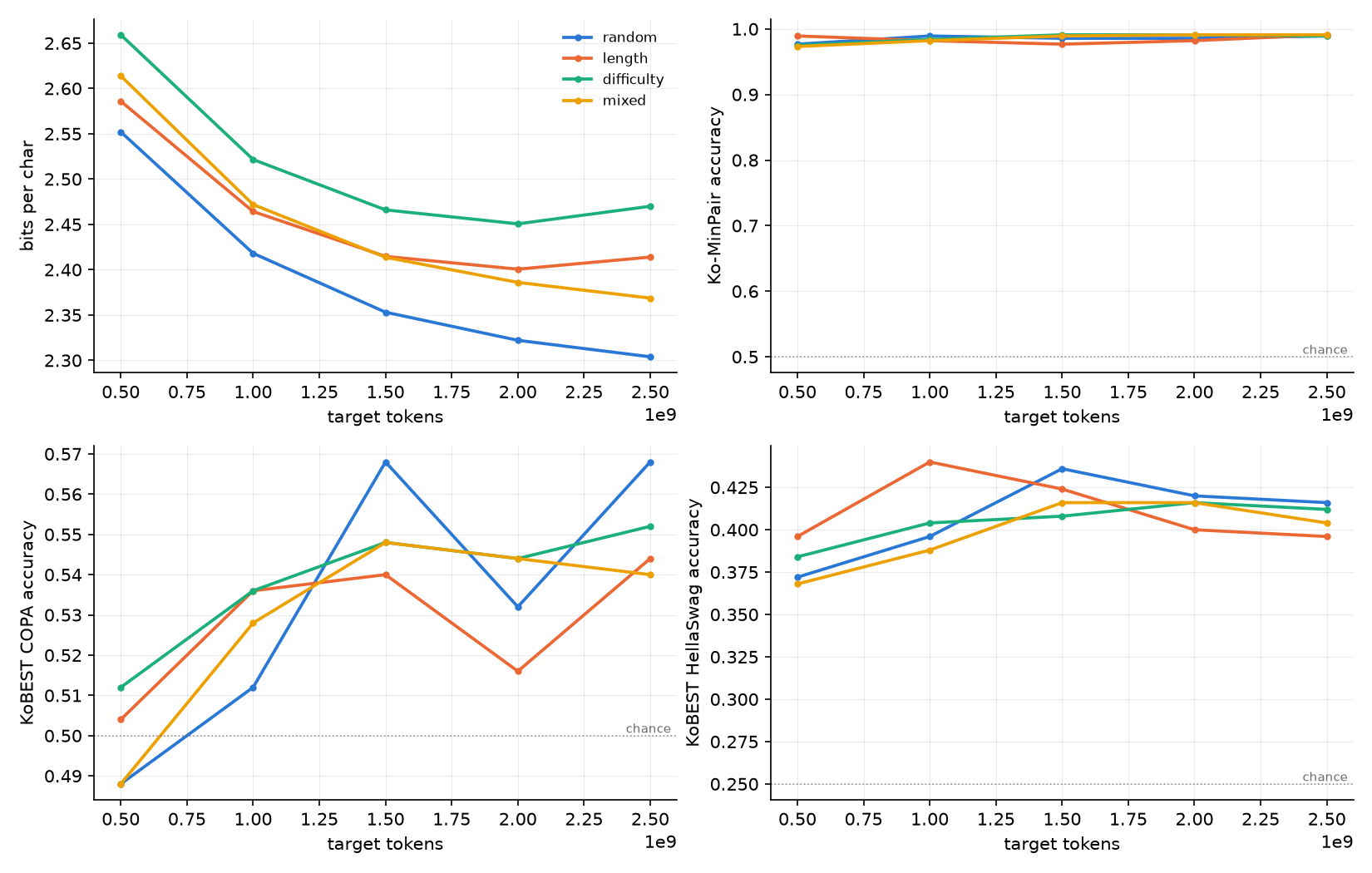
I also evaluated KoBEST, KoBALT-700, and a custom grammaticality minimal-pair set. Every condition reached 96–99% on the minimal pairs within 0.5 billion tokens, while all models remained at chance on KoBALT, so neither benchmark distinguished the conditions. Having an accuracy number is not the same as having a benchmark that can resolve differences between models at this scale. In this experiment, continuous measures—validation loss and BPC—captured the effect of data order most reliably.
Comparison with external open-weight models
I evaluated the eight final checkpoints and three external models with the same harness. Because their tokenizers differed, all options were scored by log probability normalized by character length.
| Model | MinPair | COPA | HSwag | BoolQ | SentiNeg | KoBALT |
|---|---|---|---|---|---|---|
| random (cosine) | 0.989 | 0.558 | 0.428 | 0.464 | 0.848 | 0.077 |
| mixed (cosine) | 0.991 | 0.570 | 0.402 | 0.471 | 0.762 | 0.074 |
| difficulty (cosine) | 0.989 | 0.550 | 0.414 | 0.469 | 0.835 | 0.080 |
| length (cosine) | 0.991 | 0.542 | 0.404 | 0.474 | 0.755 | 0.084 |
| random (fixed LR) | 0.989 | 0.546 | 0.434 | 0.463 | 0.802 | 0.099 |
| mixed (fixed LR) | 0.984 | 0.544 | 0.404 | 0.470 | 0.792 | 0.091 |
| difficulty (fixed LR) | 0.984 | 0.552 | 0.380 | 0.461 | 0.620 | 0.086 |
| length (fixed LR) | 0.979 | 0.532 | 0.376 | 0.464 | 0.743 | 0.079 |
| KoGPT2 125M | 0.993 | 0.558 | 0.426 | 0.473 | 0.662 | 0.096 |
| Gemma 3 270M PT | 0.980 | 0.568 | 0.488 | 0.531 | 0.585 | 0.076 |
| EXAONE 4.0 1.2B | 0.864 | 0.582 | 0.426 | 0.481 | 0.815 | 0.099 |
The external models are anchors for estimating absolute performance, not fair ranking opponents: they differ in training-data volume, tokenizer, and tuning method. EXAONE in particular is an instruction-tuned model and may be disadvantaged on MinPair, which compares raw-sentence log probabilities.
Insights from the experiment
A curriculum is a revisit schedule, not merely a sorting rule
In a one-pass curriculum from easy to difficult, difficulty becomes inseparable from training time. Easy texts
seen early are never revisited, while difficult texts seen later receive the final parameter updates. In this
experiment, the deficit for difficulty was concentrated not in the hard band (+0.017), but in the easy band
(+0.262), and the same pattern became stronger under a fixed learning rate. What mattered most was therefore not
what the model saw first, but what it never saw again.
This result suggests that sorting by difficulty alone is not enough when designing a pretraining curriculum.
Rehearsal that periodically reintroduces easy data, or interleaving across difficulty bands, must be treated as
part of the schedule. The fact that mixed lost less ground than the fully sorted conditions is consistent with
its preview of the next band making the distribution shift more gradual while also increasing the share of easy
data. Because mixed changes both factors, however, this experiment cannot separate the contribution of
previewing from that of data selection.
Data fit partly offset model size on some tasks
An unexpected result emerged from the comparison with external open-weight models. This 110M model, pretrained only on Korean, performed comparably to KoGPT2 125M and Gemma 3 270M on the grammaticality minimal pairs and achieved the highest SentiNeg score among the comparison models, including EXAONE 4.0 1.2B. One plausible interpretation is that, while much larger general-purpose models divide their capacity across multiple languages and tasks, the smaller model devoted all of its limited capacity to the Korean distribution.
This cannot be generalized into a claim that a small model understands Korean better than a large one. It showed no consistent advantage on COPA, HellaSwag, or BoolQ, and every model remained at chance on KoBALT. The comparison supports a narrower conclusion: on tasks close to the training distribution, such as grammaticality and sentiment, data specialization can partly compensate for a smaller parameter count, but it cannot substitute for reasoning capacity. Because the models also differ in training-data volume and tuning method, this is not a causal estimate of the effect of Korean-only pretraining.
Human-designed difficulty may not transfer to LLMs
Beyond Random Sampling: Efficient Language Model Pretraining via Curriculum
Learning (Zhang et al., 2025) reported faster early training for larger
English models across several curriculum settings. The experiments are not directly comparable—model scale,
language, data, difficulty metric, and training method all differ—but I likewise expected an easy-first order to
beat random training here, or at least match it. Instead, random led every curriculum condition, the opposite
of that expectation.
The per-band losses in this experiment show that even the random model ranked hard below mid. The metric intends the difficulty order easy < mid < hard, but a linguistic difficulty measure designed by humans cannot be assumed to mean the same difficulty to an LLM. Curriculum learning rests on the assumption that a model, like a human, learns from easy examples first; if the very standard of easy and hard diverges between humans and LLMs, a human-designed curriculum ends up forcing an inefficient order.
Questions for the next experiment
Does repetition eliminate forgetting?
If forgetting caused the result, the next experiment makes a clear prediction. Keeping the total token count fixed, I would like to reduce the corpus to one quarter and train for four epochs, comparing reshuffling each epoch, repetition of the full curriculum cycle (spaced), and repetition of difficulty-band blocks (blocked). I expect the increase in easy loss observed here to disappear under the cyclical schedule, which revisits the easy band periodically. It would also be meaningful as a comparison of blocked and interleaved practice from cognitive science in the setting of language-model pretraining.
Does the advantage of specialization generalize to other domains?
That a 110M model trained only on Korean performed comparably to much larger open-weight models suggests that data specialization can partly offset differences in parameter count. I would like to see whether this result reproduces in other domains.
For example, how far could a small model trained only on code compete with large general-purpose models on code syntax and autocomplete? Another interesting question is how close a small model specialized purely in image captioning, paired with a text LLM without a vision encoder such as DeepSeek V4, could come to a dedicated VLM in image understanding.
Difficulty as the LLM sees it
If human-designed linguistic difficulty metrics do not fit LLMs, the natural next step is to measure difficulty as the LLM itself experiences it. Computing per-sample loss or forgetting scores on the same corpus and comparing them with the human-designed metric would be a starting point for defining what counts as easy data for an LLM. Only with a curriculum redesigned on that basis could the question—does an LLM, like a human, learn faster from easy examples first?—finally be answered.