The starting point was the idea of having a 3D avatar express spoken Korean in Korean Sign Language (KSL). The task was not initially defined as a translation problem. After analyzing AI Hub data and the structures of Korean and sign-language morphemes, we concluded that rather than translating Korean directly into sign-language coordinates, it was better to translate into the KSL morphemes defined in the dataset and then map those morphemes to coordinates.
On the three-person team, I handled EDA and translation-model fine-tuning. Later, I used Blender to diagnose the cause of errors in the Unity animation.
Model selection
The target output was not a free-form Korean sentence but a short sequence of sign-language morphemes. Given the 8 GB local VRAM constraint and roughly 130,000 training examples, we chose the encoder-decoder architecture of koBART base over a larger generative model. Rather than begin with a model already fine-tuned for summarization or translation, I judged it better to teach the base model the sign-language output format directly from our data.
Most of the original data consisted of sentences describing disaster scenarios. We used the sign-language morphemes to prompt an LLM to generate everyday Korean sentences, expanding the training set to roughly 130,000 examples, although the generated sentences were repetitive. We also considered using a separate Korean everyday-conversation dataset as input, but excluded it because of storage constraints.
I tested gogamza/kobart-base-v2 and hyunwoongko/kobart. Because
gogamza/kobart-base-v2 continued to repeat the same output across parameter changes, I excluded
it. I selected and fine-tuned hyunwoongko/kobart, whose output was stable under the default
configuration. During these experiments, extending the input and output lengths to accommodate a
small number of long samples worsened validation loss, so I kept the maximum length at 128.
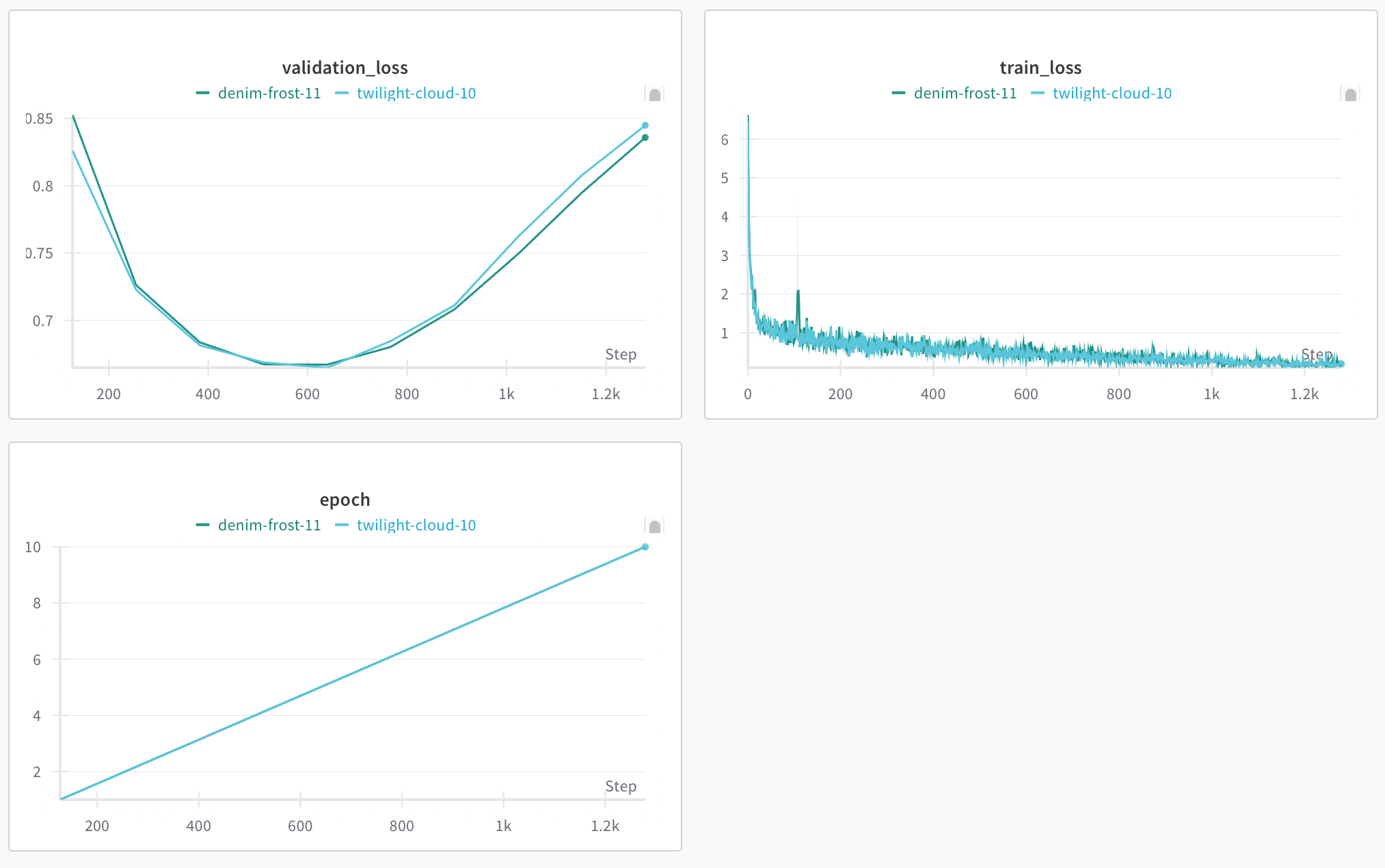
In a ten-epoch run, validation loss began rising again after roughly the fifth epoch. Judging this to be overfitting, I fixed later experiments at five epochs and saved the checkpoint with the lowest validation loss.
Another issue was that sign-language morphemes combining Korean characters and numbers, such as
먼지1#, did not map one-to-one to existing tokenizer tokens. Instead of adding a
morpheme-specific vocabulary and retraining the tokenizer, I constrained decoding so the model
could generate only token sequences corresponding to morphemes found in the dataset while
preserving the meaning carried by Korean subword units the tokenizer already knew.
Debugging
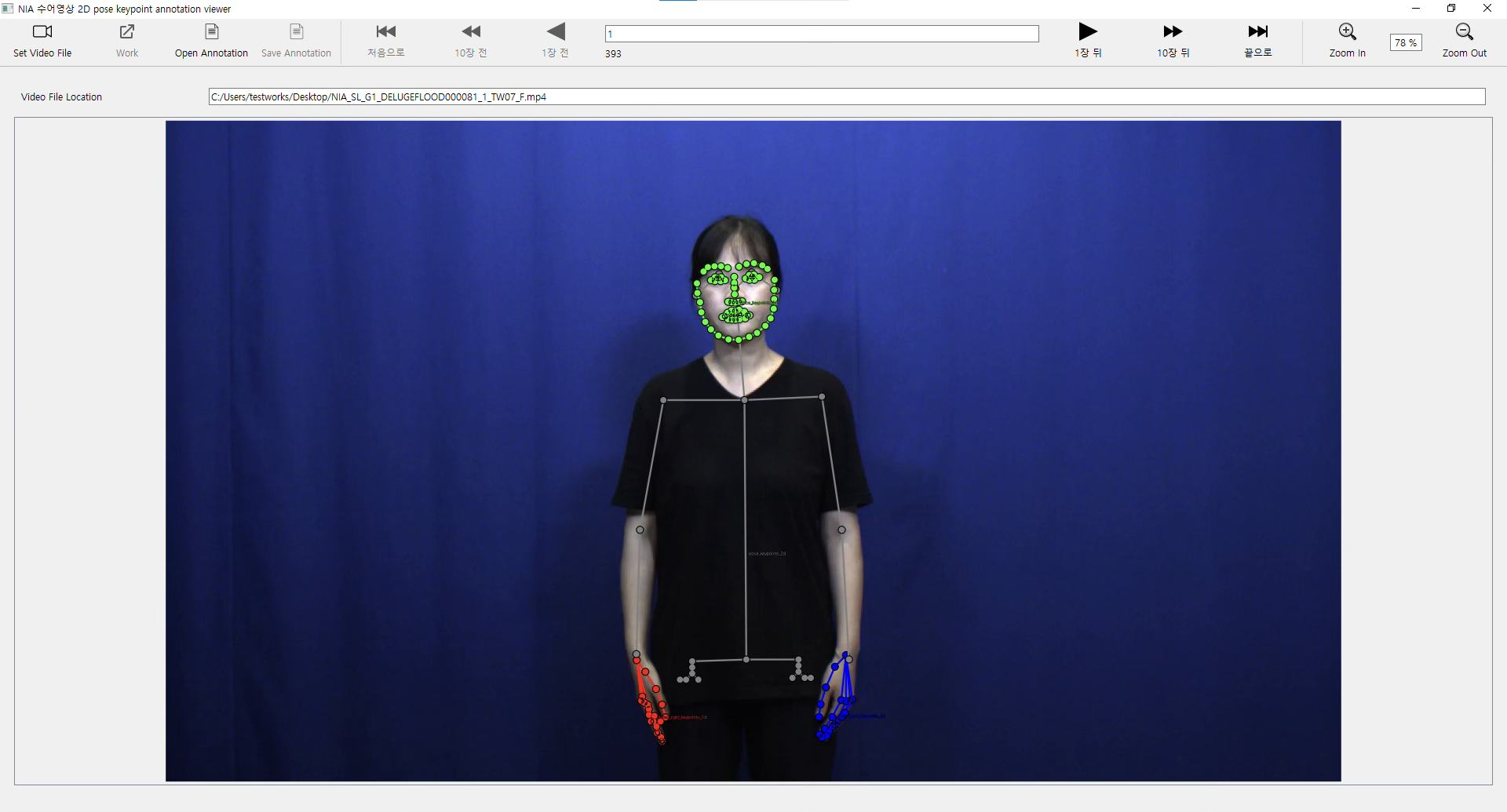
For each translated morpheme, we looked up the corresponding facial, pose, and both-hand coordinates in the source JSON and converted them into frame sequences. The image below shows the source sign-language video with facial, pose, and both-hand keypoint annotations.
A teammate applied those coordinates to a rigged model in Unity, but the character did not move correctly. This is the failed animation produced when the rig and coordinate data did not match.
After completing the translation-model work, I joined the investigation. I first used Blender to visualize the frame-by-frame coordinates for the translated sign morphemes as points, checking whether the morpheme-to-coordinate stage worked correctly.
I then removed the avatar mesh and reproduced only the point-to-rig-bone mapping.
By isolating and comparing those stages, I found that the Armature assumed by the coordinate data had a different number of bones from the downloaded rig, breaking the mapping. I documented the reproduction steps and root cause in a bug report. The teammate responsible for Unity then used that diagnosis to switch to another rigged model compatible with the coordinate structure and complete the final character animation.
Results
After changing the model and constraining its output, the system produced examples like the following. Because the model operates on Korean, the original input and morpheme output are preserved alongside an English gloss.
Korean input:
내일 오후 미세먼지 주의보가 발령되었으니 외부활동을 삼가해 주시기 바랍니다English gloss: “A fine-dust advisory has been issued for tomorrow afternoon, so please refrain from outdoor activities.” Model output:먼지1# 주의보1 밖1 하지마1 내일1 오후1
Below is the final avatar animation completed by my teammate in Unity after switching to a compatible rigged model.
The team implemented the full flow from text to sign-language morphemes, 3D coordinates, and avatar motion. My contributions were the translation model and Blender-based error diagnosis.